A new kind of AA appeared on Amazon in recent years: a lithium-ion cell in an AA jacket that outputs a regulated 1.5 volts from start to finish, marketed on its flat voltage, light weight and long runtime in demanding electronics. It has created genuine confusion alongside genuine demand, because a buyer comparing '1.5 V lithium' with '1.2 V NiMH' often assumes the lower nominal voltage is a defect. This paper traces the actual discharge curves of both chemistries, identifies the devices for which the flat 1.5-volt rail matters, and maps the equally real territory where NiMH keeps decisive advantages in surge current, cold tolerance, cycle economics and transport simplicity. For a seller such as WenJoop, the goal is not to deny lithium but to position each chemistry where it wins.
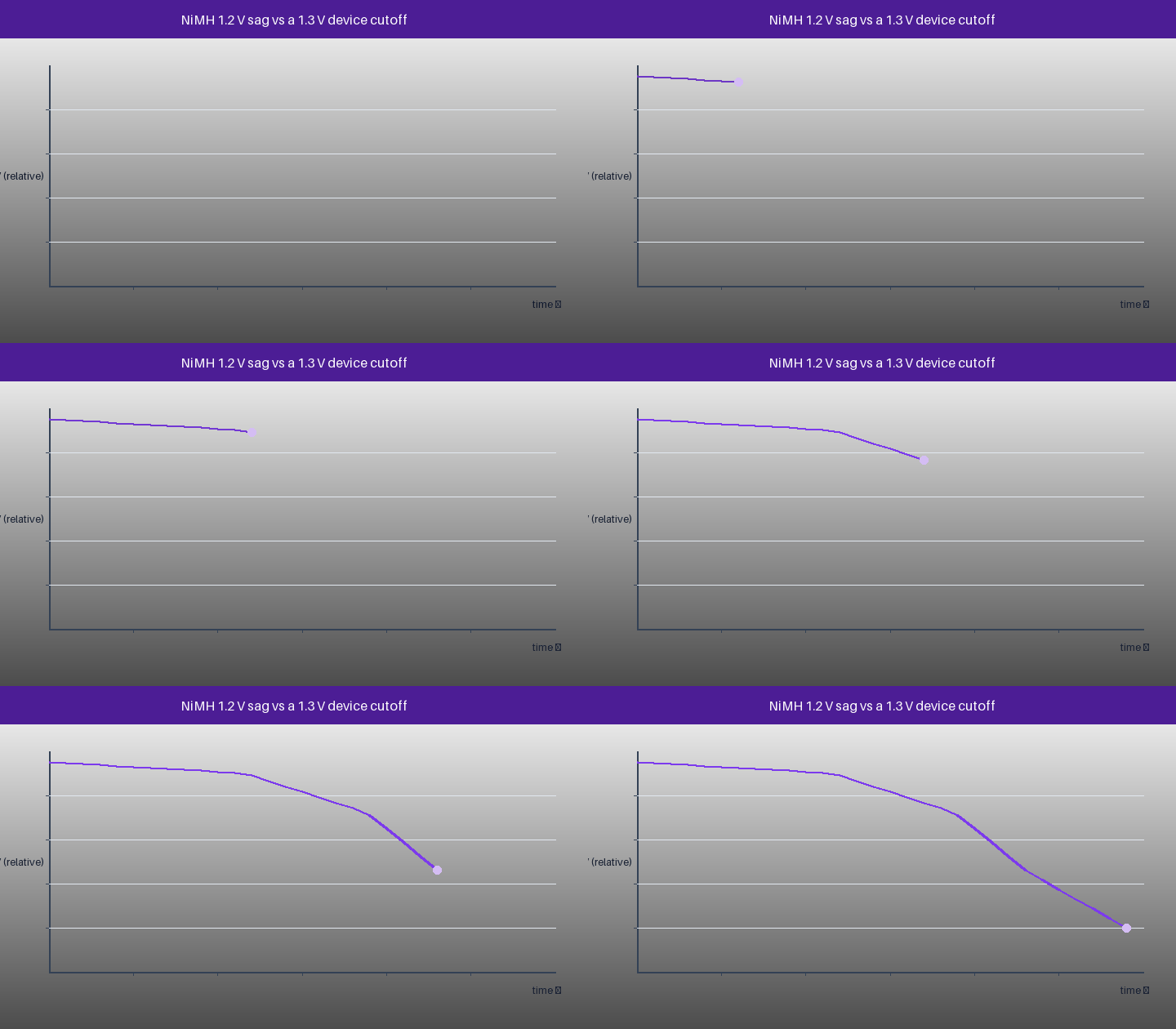
A NiMH AA has a nominal 1.2 volts but starts a fresh discharge near 1.3 to 1.4 and sags gradually toward 1.0 as capacity is drawn, with the shape steepening near the end. A regulated lithium AA is a different machine: inside the can sits a lithium-ion cell at 3.6 to 3.7 volts feeding a small buck converter that holds the output at a constant 1.5 volts until the internal cell is exhausted, at which point the output drops off sharply. The first animated figure shows the NiMH sag that a device actually sees.
The flat curve is the lithium product's headline feature. Devices that shut down at a relatively high cutoff - commonly cited around 1.3 volts for fresh alkaline assumptions - will declare a NiMH cell 'empty' while usable charge remains, whereas the regulated cell serves its full stored energy above that cutoff.
The devices that reward a flat 1.5-volt rail are specific and identifiable: battery-powered security cameras such as Blink units that wake for Wi-Fi bursts, electronic smart locks that need a confident motor pulse, high-drain flashes and some games controllers that report battery percentage from voltage. In these, a sagging NiMH cell can trigger a low-battery warning early, and the regulated lithium AA extracts more of its energy before the cutoff. This is a real, reproducible advantage and a legitimate segment for a multi-chemistry catalogue.
Most household devices - remotes, clocks, mice, keyboards, many toys, radios and solar lights - either regulate internally or draw light, steady loads and never approach a problematic cutoff; for them the flat rail adds nothing and the NiMH sag is invisible.
The second animated figure scores the chemistries across five attributes and NiMH leads on four that matter across the broad market. Surge current: NiMH has very low internal resistance and delivers the short high-current pulses a motor or flash needs without a converter in the path. Cold tolerance: NiMH operates across a published range down to minus 20 degrees Celsius, whereas lithium cells and their electronics lose performance and require protection at low temperature. Cycle economics: NiMH reaches one to two thousand cycles at low per-cycle cost (Paper 4), and transport: NiMH is not a regulated lithium good, so it avoids the UN38.3, lithium marks and hazmat review examined in Paper 10.
The lithium AA also carries two extra failure points NiMH does not have - the buck regulator and protection circuitry - and its mAh label is misleading unless converted: a '4100 mWh' lithium cell at 1.5 volts corresponds to roughly 2700 mAh-equivalent, and comparing that number directly to a NiMH mAh rating is a units error.
Regulated lithium AAs are typically some 30 to 40 percent lighter and self-discharge at roughly half the already-low rate of good LSD NiMH, both genuine benefits for travel and standby use. An honest comparison table states each property in its correct units: watt-hours of usable energy, the output-voltage shape, operating temperature range, cycle count, weight, and the transport and safety regime. A listing that hides the converter, the cutoff dependence or the mWh-to-mAh conversion will be exposed by the same analyzer-wielding reviewers discussed in Paper 6.
For NiMH listings the key explanatory job is to pre-empt the 'only 1.2 V' objection: explain that 1.2 V is the nominal of a chemistry designed for high-current use, that most devices tolerate the full 1.4-to-1.0 envelope, and name the specific devices for which a regulated lithium product is the better fit. That candour builds credibility for the recommendation in both directions.

Trying to win every device with one chemistry is the mistake. A well-architected Amazon store segments by device need: an LSD NiMH AA/AAA range for the high-volume household, controller, toy, flashlight and solar segments where cost-per-hour, surge and cycles dominate; and, if the seller chooses to carry it, a clearly labelled regulated lithium line for the narrow high-cutoff, weight-sensitive segment, supported by the lithium compliance dossier Paper 10 describes.
This segmentation also protects margin: NiMH is the recurring, high-volume, low-friction product that builds the store's review base, while the regulated lithium line is a specialist offer for buyers who specifically search for it. The OEM advantage is strongest precisely in the high-volume NiMH core, where matched lots and honest labels decide the rating.
For WenJoop the practical output is a device-to-chemistry guide embedded in A+ content and questions-and-answers: cameras and locks with high cutoffs toward regulated lithium; virtually everything else toward LSD NiMH, with the 1.2-volt nominal explained and the surge, cold, cycle and transport advantages stated. Pair the NiMH recommendation with the correct charger (Paper 9) and the cost-per-hour model (Paper 4), and the buyer reaches the right product equipped to defend the choice.
One of the highest-volume 'everything else' segments is outdoor solar lighting, whose batteries are almost universally NiMH and whose daily charge-discharge duty is unlike any other consumer device. Paper 8 opens that hidden workhorse of the Amazon NiMH category.
Weijiang Power manufactures welded consumer AA, AAA and specialty-size nickel-metal hydride cells and matched packs for private-label and brand sellers on Amazon and other marketplaces, with lot-matched capacity, IEC 61951-2 performance files and IEC 62133-1 safety support. Share your target format, cycle claim, pack configuration and marketplace, and our team will design a defensible, review-resilient NiMH programme. Review the line on the products page.


