Among the highest-volume and least discussed NiMH applications on Amazon is the solar garden light. Millions of low-cost path lights, deck lights and decorative stakes are sold every season, and virtually all of them run on a small rechargeable nickel-metal hydride cell - usually an AA of 600 to 800 mAh or a compact two-thirds-AAA measuring roughly 10 by 28 millimetres - because NiMH tolerates the crude charge control, shallow daily cycling and outdoor temperature that a lithium cell would not. Replacement cells are themselves a steady, repeat-purchase market. This paper reconstructs the garden light's daily duty, explains why it favours NiMH so strongly, and specifies what an OEM-backed seller such as WenJoop must build to turn a one-season product into a multi-season one.
A solar light's battery lives a metronomic life. At dusk the panel voltage falls, the controller switches on the LED and the cell discharges slowly through the night at a small current; at dawn the LED switches off and the panel charges the cell through the day. The first animated figure plots this duty over twenty-four hours, with the daylight charging current shown as a negative-going solar input and the night-time LED load as a positive discharge - a single shallow cycle repeated every day for years.
Because the LED current is small and the night is finite, each cycle uses only a fraction of the cell's capacity: a deliberately shallow depth of discharge that, in principle, is gentle on cycle life. Whether that gentleness is realised depends almost entirely on how the two extreme seasons are handled.
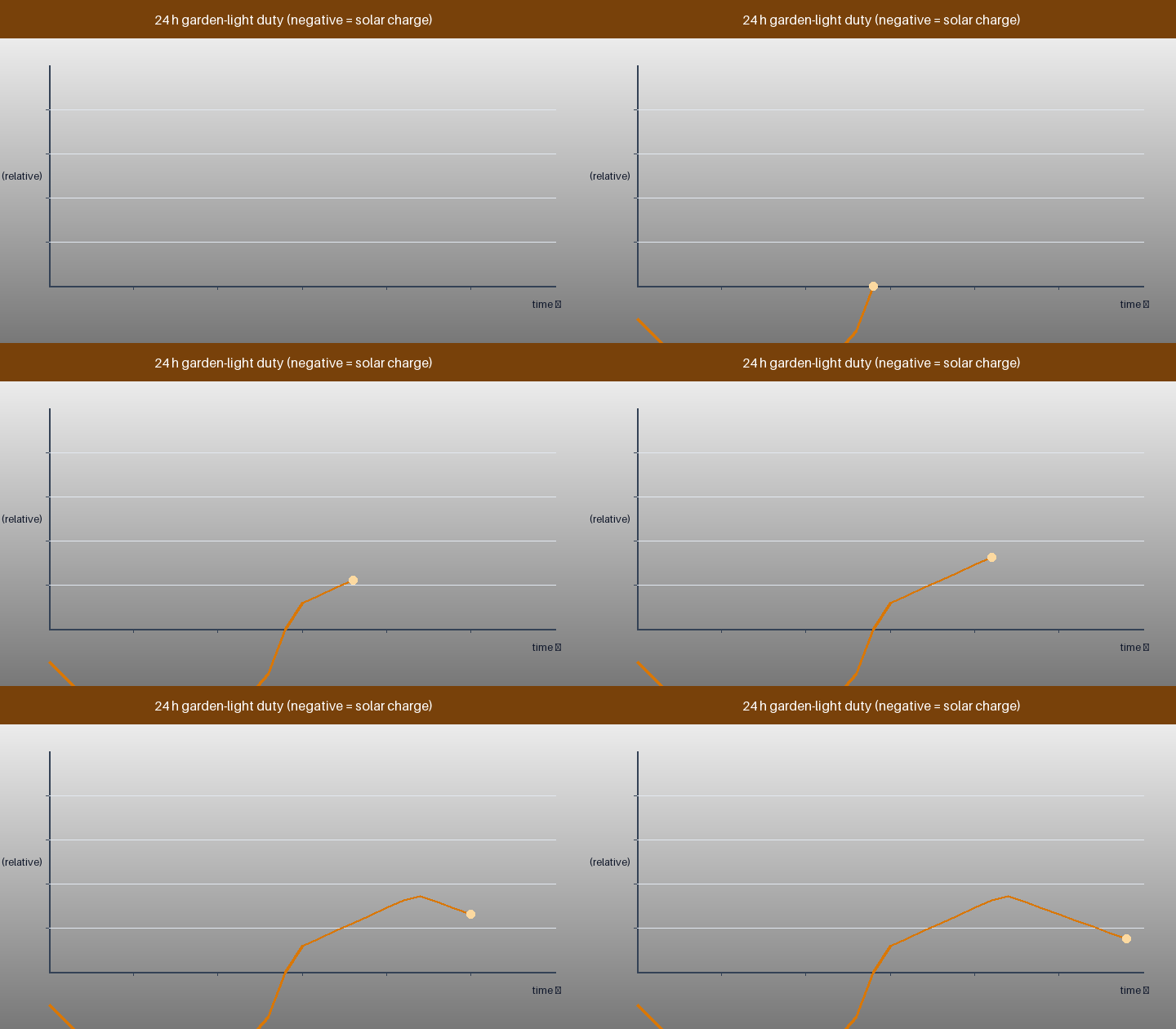
The controller in a five-to-twelve-dollar light is simple - often a basic charge path with no minus-delta-V termination of the kind described in Paper 9. In summer, long days and strong sun push more energy into the cell than the short night consumes, so the cell sits overcharged for hours, day after day. NiMH tolerates sustained mild overcharge far better than lithium, which is the first reason it owns this application - but only if the cell is built with adequate recombination and pressure tolerance, otherwise it loses water, dries out and dies by autumn.
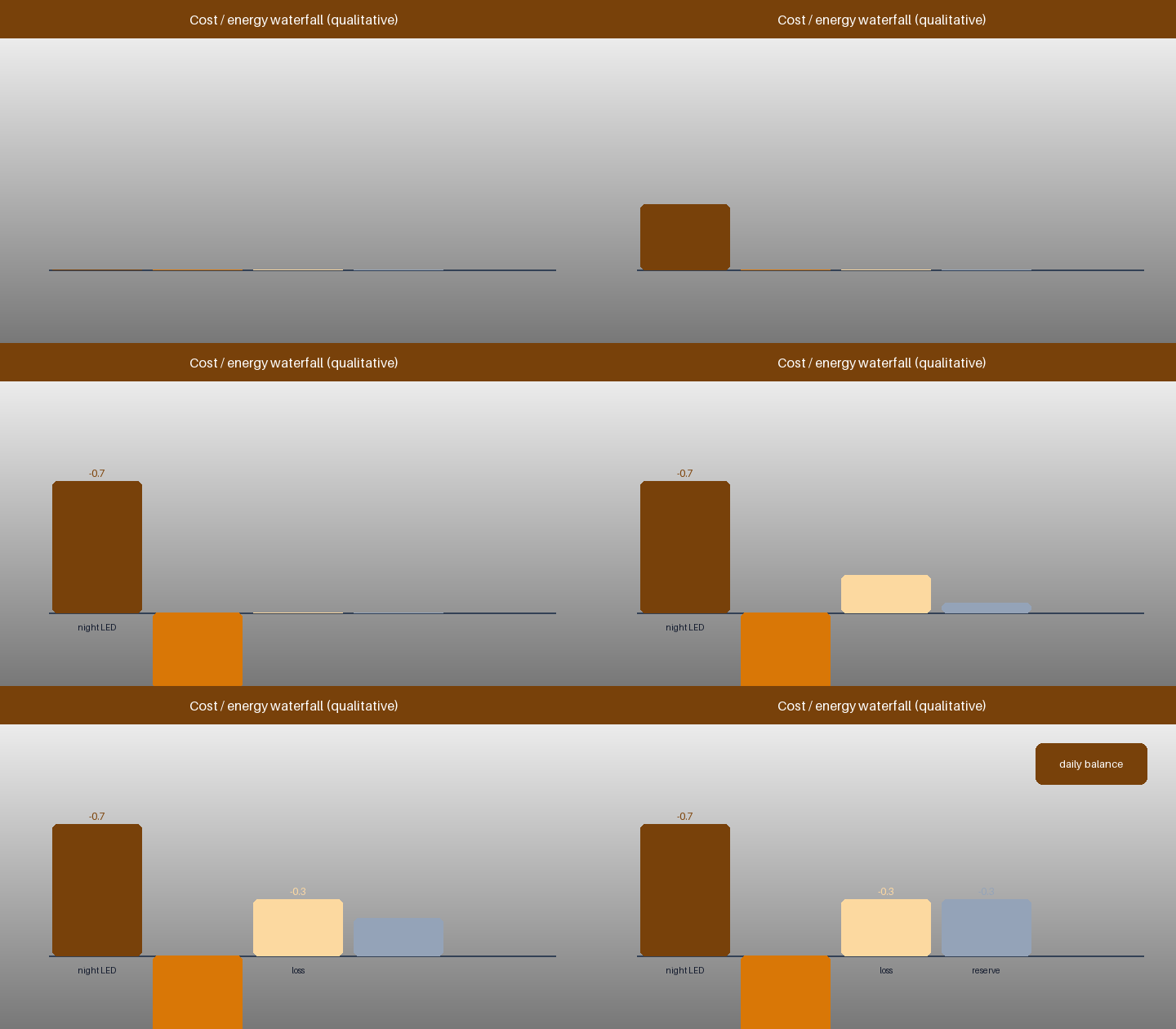
Winter reverses the problem: short cloudy days cannot replace what long nights consume, so the cell is chronically undercharged and can be driven into deep discharge or even reversal across a string. The second animated figure is the daily energy waterfall - night load, daylight harvest, conversion losses and the reserve that separates a light that survives January from one that does not.
The AA dominates because it balances capacity, cost and a familiar holder; the two-thirds-AAA, at about 10 by 28 millimetres, fits the compact stakes where an AA will not physically go. Typical capacities run from roughly 300 mAh in the smallest two-thirds-AAA through 600 to 800 mAh in a standard AA, with oversized 1200 mAh AAs used in brighter or longer-run fixtures. Lithium AAs appear in a minority of premium cold-climate lights, but their protection electronics and intolerance of crude overcharge make them a poor default at this price point.
The replacement market is where a battery specialist wins: when an installed light dims after a season, the buyer searches not for a new light but for the exact replacement cell, and a listing that explains the size and capacity choice captures a high-intent, repeat purchase with little competition from the light makers themselves.
Surviving thousands of shallow cycles with seasonal overcharge asks for specific design choices: an alloy and electrode formulation stable under light overcharge, a safety-vent and recombination design that handles the summer pressure, sufficient electrolyte reserve to resist dry-out, and capacity matched to the local night length rather than maximised on paper. Dimensional consistency matters because garden-light holders are often moulded tightly, and tab or solder options matter for the fixtures that weld rather than spring-load the cell.
Lot consistency is unusually valuable here: a single weak cell in a multi-cell fixture is reverse-charged by its stronger partners and fails, taking the whole light down - the same matching principle that protects consumer packs, applied outdoors.
Solar-light battery reviews follow a tell-tale calendar. Complaints cluster in late winter - 'worked all summer, now dim/dead' - which is precisely the signature of chronic undercharge combined with summer dry-out rather than an early defect, and in early summer for cells that arrived mismatched to the fixture. A seller who understands the duty can pre-empt both with capacity guidance by latitude and season, a note that the first one or two sunny days are needed to bring a replacement to full charge, and an honest statement of expected seasons rather than an inflated lifetime claim.
This is another case where the failure-mode taxonomy of Paper 6, read alongside the actual duty, tells the OEM exactly which process control to tighten.
For WenJoop the opportunity is a focused, evergreen product line: AA and two-thirds-AAA cells in the common capacities, with correct millimetre dimensions, overcharge-tolerant construction, matched lots, and both plain and pre-tabbed options; listings built around a size-selection guide and a latitude-aware capacity recommendation; and multi-packs sized for the typical household's number of lights, which is precisely the kind of recurring, high-volume demand that anchors a consumer NiMH catalogue.
Every one of those cells will be charged by the simplest of chargers - the sun through a cheap controller - which makes the next paper, on how proper chargers terminate a charge and why the charger is half the product, the natural companion.
Weijiang Power manufactures welded consumer AA, AAA and specialty-size nickel-metal hydride cells and matched packs for private-label and brand sellers on Amazon and other marketplaces, with lot-matched capacity, IEC 61951-2 performance files and IEC 62133-1 safety support. Share your target format, cycle claim, pack configuration and marketplace, and our team will design a defensible, review-resilient NiMH programme. Review the line on the products page.


