
Temperature is the most informative signal a low-cost NiMH charger can measure, and it becomes meaningful only when the sources of heat are understood. The warmth of a charging cell is the sum of three physically distinct terms: irreversible Joule and overpotential heating that scales with current and internal resistance; a smaller reversible entropic term that changes sign between charge and discharge; and, decisively at end of charge, the heat released when oxygen generated at the positive is recombined at the negative. This paper builds the charge thermal budget term by term, shows why the temperature-rise rate accelerates so sharply when a cell becomes full, and uses that accounting to explain the widely used one-degree-Celsius-per-minute termination criterion.
Whenever current crosses a resistance it dissipates I-squared-R heat; in a NiMH cell that resistance is the sum of ohmic contributions from electrolyte, separator, electrodes and tabs plus the 'polarization resistance' representing kinetic and concentration overpotentials. This irreversible term is present throughout charge, scales roughly with the square of current and grows as internal resistance rises with age and at low state of charge.
Because it scales with current squared, the irreversible term punishes high rates disproportionately: doubling charge current roughly quadruples the baseline resistive heating, which is why fast charging is inseparable from thermal management and why an aged, higher-impedance cell runs hotter even under an identical profile.

Electrochemical reactions also carry an entropic heat component, T times dS, tied to the reaction entropy; it is reversible in the sense that it changes sign between charge and discharge and varies with state of charge as the electrode phase composition changes. In NiMH it is usually smaller than the irreversible and recombination terms during a fast charge, but it must be included in accurate thermal models and it contributes to the subtle temperature dependence of the charge voltage curve.
An energy-balance model that omits entropy will slightly mispredict mid-charge temperature, which matters when temperature is used not just as a cutoff but as a quantitative state estimator - the subject of a later group of papers.
The decisive thermal fact about NiMH is that overcharge is essentially 100 percent inefficient in energy terms: current that recombines oxygen around the internal loop performs no net storage and releases its energy as heat. As the cell fills and an increasing fraction of current is diverted into this loop, total heat generation rises even though current is held constant - the signature a thermistor detects as an accelerating temperature rise.
This is why temperature, unlike voltage, becomes more informative near full charge rather than less: while the -delta-V shrinks at high temperature, the rate of heating grows. Manufacturers' guidance converging on a maximum temperature-rise rate near 1 degree C per minute and an absolute cutoff around 50 to 60 degrees C is a direct empirical encoding of this thermal budget.
A lumped thermal model writes cell heat capacity times dT/dt as the sum of the three generation terms minus heat lost to the surroundings; heat capacity for a small cylindrical cell is dominated by its mass and steel can, while the thermal resistance to ambient sets the steady temperature a given dissipation reaches. Such a model predicts the observed charge profile: a gentle resistive warming in bulk charge, a distinct inflection when recombination becomes dominant, and - if charge continues - a steep climb toward the absolute cutoff.
Designers use the model backwards as well: given a maximum allowed cell temperature and a known thermal resistance to the charger housing, it yields the maximum sustainable charge current, and given a measured dT/dt it estimates the fraction of current already being lost to recombination - an implicit state-of-charge and health signal.
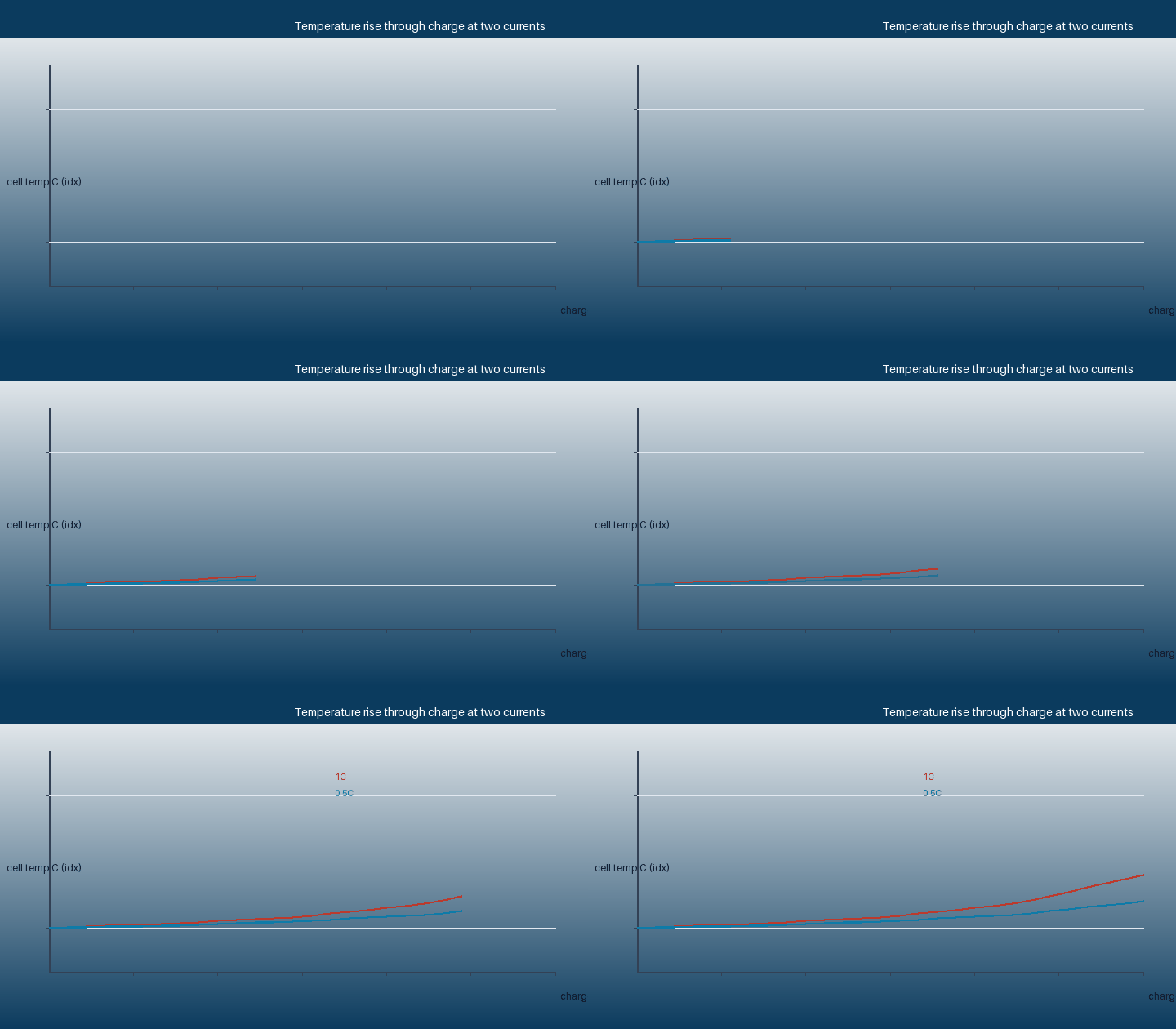
The rate-of-rise is robust because it is self-referencing: it does not depend on an absolute temperature calibration or on knowing ambient precisely, and it responds to the very mechanism - runaway recombination - that safe charging must prevent. Charge-management ICs such as the TI bq2002 family implement rate-of-temperature-rise termination alongside -delta-V, maximum voltage, maximum temperature and maximum time precisely because the thermal and voltage signals fail under opposite conditions and together cover the full envelope.
It can still mislead. A cell moved from a warm pocket into the charger, a thermistor mounted to the PCB rather than the cell, or a charger cooling fan switching on and off can all create dT/dt transients unrelated to recombination; robust designs debounce the signal over several samples and combine it with absolute-temperature and voltage gates, as the Design-Note practice of requiring four consistent 30-second samples illustrates.
Thermal design couples cell, current and enclosure: choose a current whose I-squared-R baseline leaves headroom for the recombination-driven rise at end of charge; place the NTC sensor in genuine thermal contact with the cells and average across a multi-cell pack; design the enclosure and any airflow so the lumped thermal resistance is known and the absolute cutoff is reached only as a genuine fault backstop; and use top-off at reduced current so the final few percent are added without sitting in the high-recombination regime.
Documenting the expected dT/dt signature of a production cell - the bulk-charge baseline, the end-of-charge inflection and the current at which 1 degree C per minute is reached - lets charger partners set thresholds from data instead of generic rules. With the heat sources accounted for, the next paper examines the voltage phenomenon the recombination heat creates: the small but crucial end-of-charge voltage peak and negative delta-V.
Weijiang Power designs and manufactures nickel-metal hydride cells, matched packs and charging-ready configurations for consumer, industrial, medical and mobility customers, and supports partners with charge-protocol guidance, IEC 61951-2 performance files, IEC 62133-1 safety evidence and charger co-validation. Share your cell format, charge rate, thermal envelope and cycle target and our engineers will specify a cell-and-charge combination that protects both runtime and service life. Review the range on the products page.


