A smart gas meter combines the energy discipline of a ten-year sealed instrument with two demanding pulses: a daily cellular or LPWAN transmission, and - far more important for safety - the motorised valve that must close on command or on detection of an abnormal flow. Because the meter sits in a potentially explosive atmosphere, its battery design is governed not only by EN 1359 and OIML R137 metrology and MID legal conformity but by ATEX intrinsic-safety limits on stored energy. This paper unpacks that load profile and the place of a nickel-metal hydride pulse reservoir beside the primary lithium cell.
Diaphragm gas meters in Europe are built to EN 1359, with metrological requirements aligned to OIML R137 and supplementary electronic devices addressed by EN 16314; legal metrology follows the MID modules (commonly B plus D). Manufacturer datasheets - from Honeywell to CHINT and Goldcard - cite MID accuracy class, EN 1359, OIML R137 and an ATEX zone rating (Zone 0 inside the meter, Zone 2 for many installations), an operating range around -25 to +55 C and ingress protection of IP65-IP67.
The ATEX dimension is what separates gas-meter power design from water-meter design: every electrical source in an explosive atmosphere must respect intrinsic-safety limits on current, voltage and stored energy so that no single fault can ignite the gas. The battery and any pulse reservoir are part of that analysis, not exempt from it.
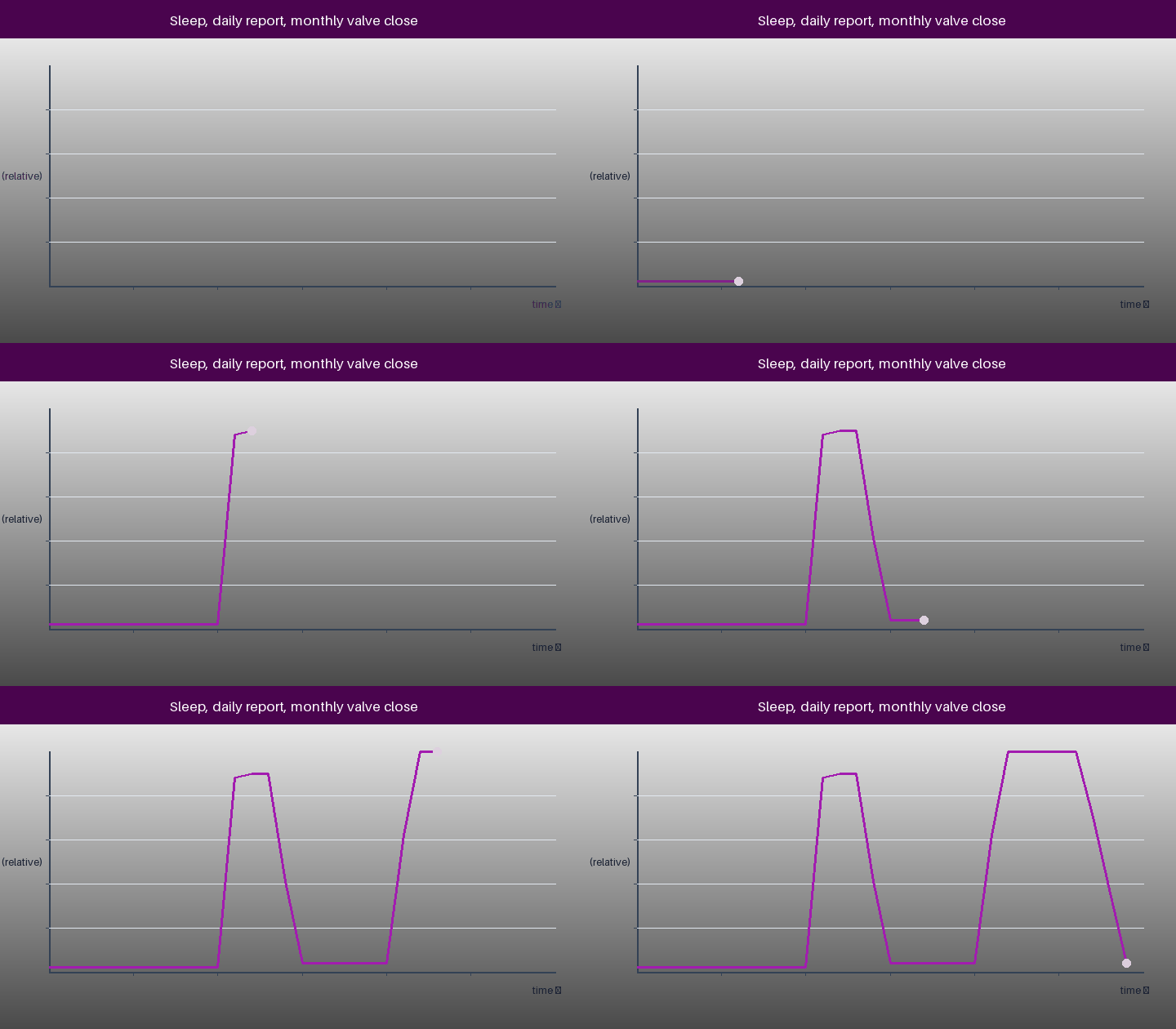
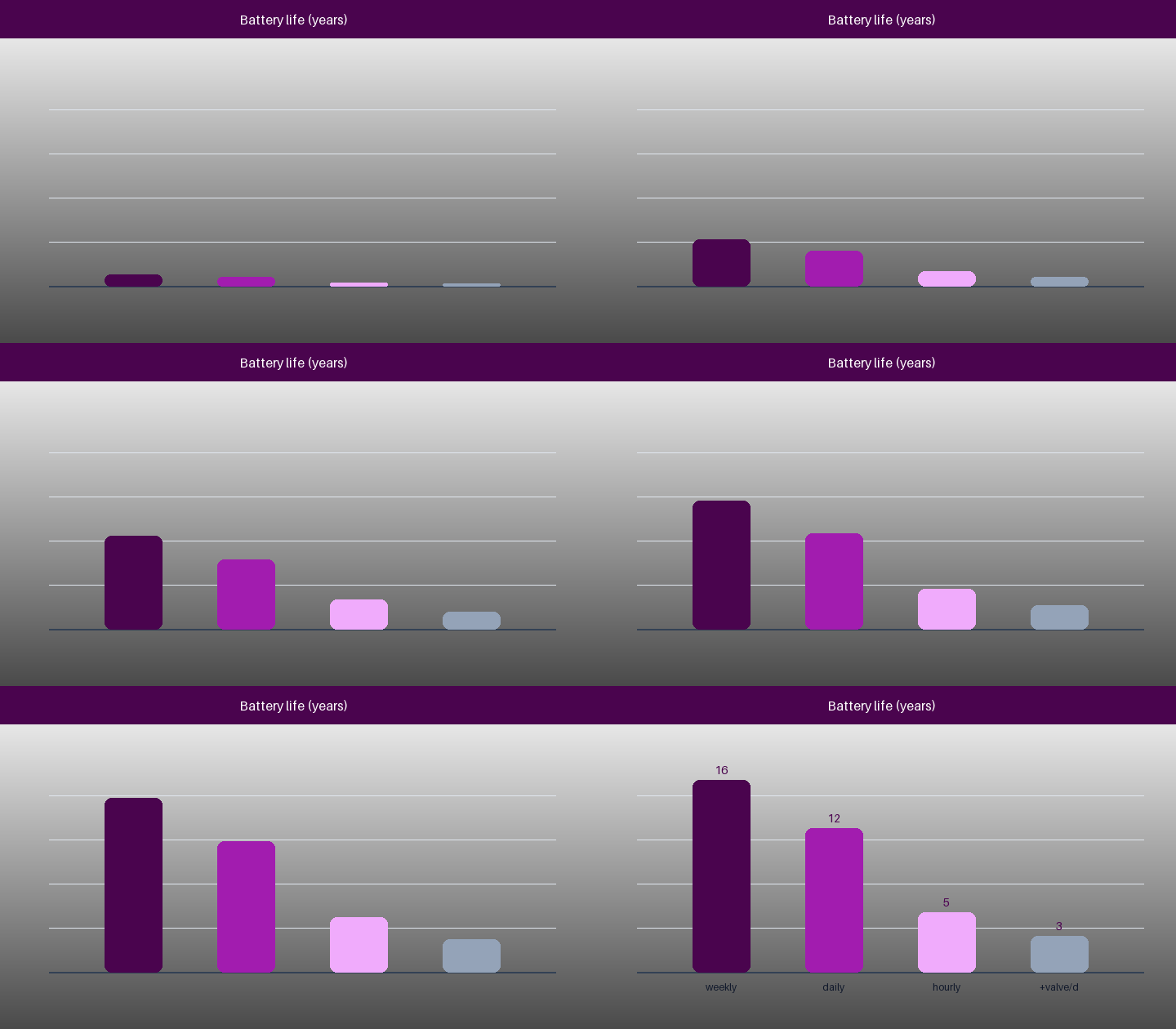
The first animated figure traces the meter's electrical life. For almost all of it the index, MCU and radio sleep at tens of microamps. At the reporting interval - once a day is typical for NB-IoT, more often for LoRaWAN - the radio attaches and transmits for seconds at a high current. Then, rarely but decisively, the motorised ball valve turns to close (or reopen), drawing a motor pulse for the seconds of its travel. Datasheets illustrate the life arithmetic directly: one vendor rates an ER26500 3.6 V 8.5 Ah primary cell beyond twelve years when reporting weekly and operating the valve once a month.
The daily report is a reliability event; the valve is a safety event. A meter that can report but cannot close on command has failed its core protective function, so the valve pulse must be guaranteed at end of life and at low temperature.
As in water meters, the default energy store is a 3.6 V primary lithium cell (Li-SOCl2, commonly an ER26500 or a pair of D cells) valued for energy density and a decade-plus life. Its high internal impedance and passivation are poorly matched to both the radio PA and especially the valve motor, whose stall and running current can collapse a primary cell's voltage at -25 C. The standard remedy is a pulse reservoir that delivers the peak while the primary cell recharges it slowly.
A sealed NiMH cell or small pack is an effective reservoir: low internal resistance and a flat 1.2 V plateau drive the motor and radio pulse repeatedly, it accepts the slow trickle charge from the primary cell across thousands of daily events, and its aqueous chemistry is benign inside a sealed, safety-rated enclosure.
The second figure quantifies the two levers operators control. More frequent uploads shorten life because every cellular attachment carries a fixed energy cost, and more frequent valve operations shorten it further because a motor pulse dwarfs a radio burst. Vendor ratings of eight to sixteen years are not contradictions; they are different points on this surface, from a conservative weekly report and monthly valve to a demanding daily or hourly profile.
A correctly sized NiMH pulse layer makes the high-current events efficient - the primary cell is never asked to source the peak directly - which flattens the penalty of frequent reporting and protects the guaranteed valve action even as the primary cell ages.
In an ATEX meter the reservoir itself must be assessed: its short-circuit current, the energy it can release into a fault, and the protection (series resistance, fusing, current limiting) that keeps the circuit inside the intrinsic-safety boundary for its gas group and temperature class. A modest, well-matched NiMH pack with defined internal resistance is easier to analyse and protect than an oversized store, and it avoids the additional thermal-management complexity of a rechargeable lithium cell in a Zone-0-adjacent enclosure.
The design file therefore records not just capacity but worst-case short-circuit and pulse currents, the protection components and their failure modes, and the temperature classification - evidence an ATEX assessor expects.
The brief for a gas-meter battery records the sleep current, radio technology and attach profile, the valve motor current and travel time, the worst-case temperature, the ATEX category and the target life. Paper B converts these into a hybrid energy and pulse calculation under intrinsic-safety constraints; Paper C maps the design onto EN 1359, OIML R137, MID, ATEX and the cell-level evidence.
Weijiang Power manufactures sealed nickel-metal hydride cells and pulse-assist modules for smart gas meters and safety shut-off actuators. Send us your radio profile, valve motor current and travel time, ATEX category and temperature class, and our engineers will design an intrinsically safe, welded NiMH pulse reservoir or service module matched to the primary lithium cell. See formats on the products page.


